
Professional Landscape Lighting Installation
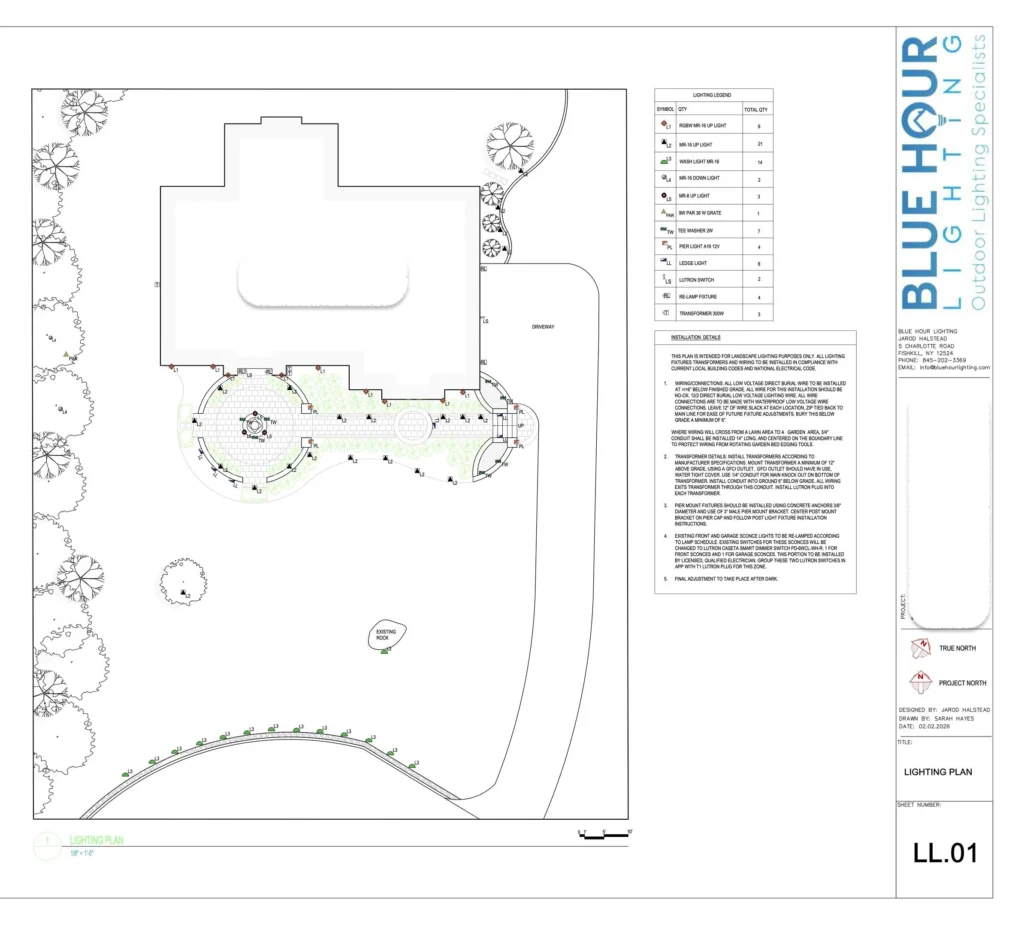
Nobody wants to find out what a lighting plan looks like by watching their yard get dug up. So we settle that question on paper. You get a full plan based on photographs of your own home, showing every fixture, which way it aims, what it draws in watts, and how the wire reaches it. We won’t purchase hardware or begin installation until the complete plan has been approved.
What a Landscape Lighting Design Actually Includes
You then get an architectural-grade plan using photographs of your own house, showing:
- Every fixture position and the direction it aims
- Fixture type and wattage for each position
- Transformer locations and the cable paths between them
- Which zones are connected
The Installation Process, Step by Step
Layout
Before we start, we place every fixture exactly where the plan puts it, so you can walk the yard and adjust anything that doesn't feel right.
Trenching
Wire goes into the ground in shallow trenches, generally around six inches deep, clear of irrigation lines and root zones.
Transformer mounting
The transformer goes on the house or a post near an exterior outlet, high enough to stay out of the snow.
Cable pulls and connections
Cable is drawn out to each zone and joined with waterproof connectors.
Light install
Each landscape light is set, staked or mounted, and leveled.
Night tuning
After dark, we aim every fixture with you there, then test each zone to confirm it's running the way it should.
Keeping Low Voltage Bright
Transformers, Wire & Voltage Drop
Voltage drop is where most DIY installs go wrong. We calculate total wattage and cable distance before installation begins. Pushing current down a long, thin cable causes the voltage at the far end to sag. LED fixtures tolerate more of this than old halogen lights did, but past a certain point, the far lights dim, shift color, or fail early.
There are three levers, and a good design optimizes all of them:
Transformer Capacity
Transformer capacity isn't something to eyeball. We keep every load under about 80 percent of a transformer's rating. Push past that and a transformer runs hot, ages faster, and can fail years before it should. On larger properties, that means multiple transformers, placed near the lights they serve.
Wire Gauge
We use direct-burial cable, starting at 12-gauge and stepping up to heavier cable as the distance and the load grow. Undersizing the cable to save money is the most common mistake we find on systems we're asked to repair.
Circuit Layout
How the lights are grouped matters as much as the wire. A hub layout, a loop, or a T split all balance the load differently, and the right one depends on where the fixtures actually sit.
Connections Matter
We use waterproof, gel-filled, or heat-shrink connectors, built to last outdoors for years. Twist-on wire nuts wrapped in tape are a shortcut, but they only hold for a season before corrosion sets in. By the time it fails, it's the middle of winter, the worst possible time to lose part of your lighting system.
Your Yard After Landscape Lighting Installation
Fixture Types and Where We Install Landscape Lighting
Uplighting and Accent Lighting
Fixtures sit at the base of a tree or wall and aim up, which is what gives your yard depth and a considered look that can only happen when design does its job and effectively disappears from awareness.
Path and Walkway Lighting
Low path lights put light on the ground, spaced so the light pools overlap slightly. The classic mistake is spacing them evenly, like runway markers.
Downlighting and Moonlighting
We mount fixtures and aim them through the branches, giving them a natural, moonlit effect.
Grazing
A light set close to a wall throws its beam across the surface and brings out the texture of the stone or brick.
Facade and Front Lawn Lighting
Your home's facade is lit in a balanced manner that makes the front door the focal point, and your lawn's features are lit to bring depth and beauty to the entire property.
Step and Safety Lighting
Every stair gets a step light, and other trouble spots, such as grade breaks where the ground suddenly changes level, pool edges, and dark corners, get the right fixture for the job.
Hardscape Lighting
We build light into each step, wall, and pillar. See hardscape lighting for that work in detail.
Fixture Brands, Materials, and Color Temperature
Do You Need a Licensed Electrician?
- Our team's electrical engineering background makes that hand-off simple. We know exactly what to ask for, so the electrician isn't guessing at what a landscape lighting installation needs.
Fine -Tuning at Night
Low-Voltage Landscape Lighting Maintenance
The LED lamps in these fixtures are rated for tens of thousands of hours, so a low-voltage lighting system can go years between lamp changes. Every installation includes a one-year workmanship warranty, and after that most clients move to a maintenance plan: two visits a year, spring and fall, to re-aim, clean lenses, replace failed lamps, repair wiring, and reset timers. We also check transformer load on every visit.
The Cost of Outdoor Lighting Installation
There isn’t an average worth quoting, because the same fixture count lands at very different numbers on different properties. What actually moves the figure:
How much of the yard is being lit
A front facade and a walkway are a different project from a whole property.
Fixture count and placement
Lights at the base of a tree fifteen feet from the transformer cost less to install than the same lights 200 feet out across a driveway.
Transformer capacity
How many transformers are needed and where they should go.
Wire length
Distance drives both cable gauge and labor.
Material grade
Brass, copper, and stainless behave and last differently from cast aluminum, and they're priced differently.
Trenching conditions
Open ground is quick. Established beds, mature root systems, and hardscape crossings take more time.
Zoning
Each independently controlled area adds capacity and control cost.
Landscape Lighting Across Westchester and the Hudson Valley
We install landscape lighting throughout Westchester County, Dutchess County, Rockland County, and Greenwich, Connecticut, and we hold the licenses each place requires.
Ready to start? Request a free consultation, and we’ll set up a walkthrough of your yard, or call 845-202-3369.